Blog 21: Advanced Aerodynamics Explained Simply
- Aalisha Sugur

- Apr 27, 2025
- 2 min read
“Aerodynamics is the invisible force that lets us leave the ground — understanding it transforms flying from guesswork to mastery.” — Aalisha, Student Pilot | Princeton Flying School
When I first looked up and saw an airplane soaring effortlessly, I marveled at how such a heavy machine stays aloft. Early in my training, aerodynamics felt like a complicated science reserved for engineers, but as I delved deeper, I realized that grasping the core principles made all the difference in how I flew and understood aircraft behavior.
This blog breaks down advanced aerodynamic concepts in simple terms, sharing what I learned about lift, drag, stall, and maneuvering forces that every pilot should understand.
The Basics: Lift and Drag
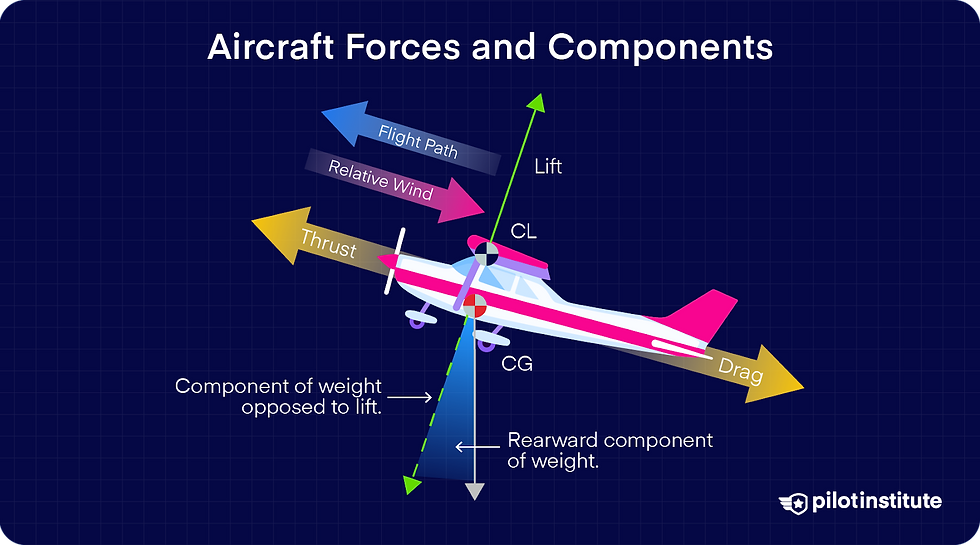
Lift: The upward force that opposes gravity. Lift is generated by air flowing over the wing, creating a pressure difference. I learned that even small changes in angle or speed dramatically affect lift.
Drag: The resistance force opposing the aircraft’s forward motion. It’s divided into parasitic drag (from the aircraft’s shape and surface) and induced drag (from creating lift). Understanding this balance helped me optimize speed and fuel efficiency.
Angle of Attack and Stall
Angle of Attack (AOA): The angle between the wing chord line and the relative airflow. This is critical—it determines how much lift is produced.
Stall: When the AOA exceeds a certain critical limit, airflow separates and lift collapses—leading to a stall. This wasn’t just a textbook concept when I experienced stall training firsthand—it demanded precise control and respect.
How Lift Changes in Flight
During takeoff and climb, maximum lift is crucial to get off the ground.
In cruise, lift balances weight at steady speed—too much drag reduces efficiency.
During turns, lift must increase (by increasing AOA or speed) to counteract centrifugal forces pulling the plane outward.
Control Surfaces and Their Aerodynamic Effects
Ailerons: Control roll; altering airflow on the wings to bank the aircraft.
Elevators: Control pitch; changing the angle of the tail to raise or lower the nose.
Rudder: Controls yaw; shifts the aircraft’s direction left or right on the vertical axis.
Learning how these surfaces affect airflow and aircraft attitude helped me fly coordinated and smooth maneuvers.
The Impact of Weight, Balance, and Air Density
Aerodynamics isn’t just about wings — factors like aircraft weight, center of gravity, and air density (affected by altitude and temperature) significantly affect performance.
Higher density altitude (hot or high locations) reduces lift and engine efficiency, a concept critical to safe departures.
Heavier aircraft need higher speed or AOA for the same lift, implying longer takeoff runs and slower climbs.
Simulator Practice and Real-World Applications
Using flight simulators to experiment with stall recovery, steep turns, and speed control reinforced my understanding of aerodynamics. It also made me appreciate the physics behind what I felt in the cockpit.
Final Thoughts: Aerodynamics in Every Flight
Aerodynamic principles are woven into every part of flying—from takeoff to landing and every maneuver in between. Grasping these ideas gave me deeper respect for my aircraft and greater control in the air.
Keep learning, keep flying, and let the invisible forces take you higher.
Aalisha - Student Pilot | Drone Certified | Future PPL | Aviation Blogger


Comments